
I. The Cause — How It All Began
1. Borrowing the Treasure from the Dragon Palace
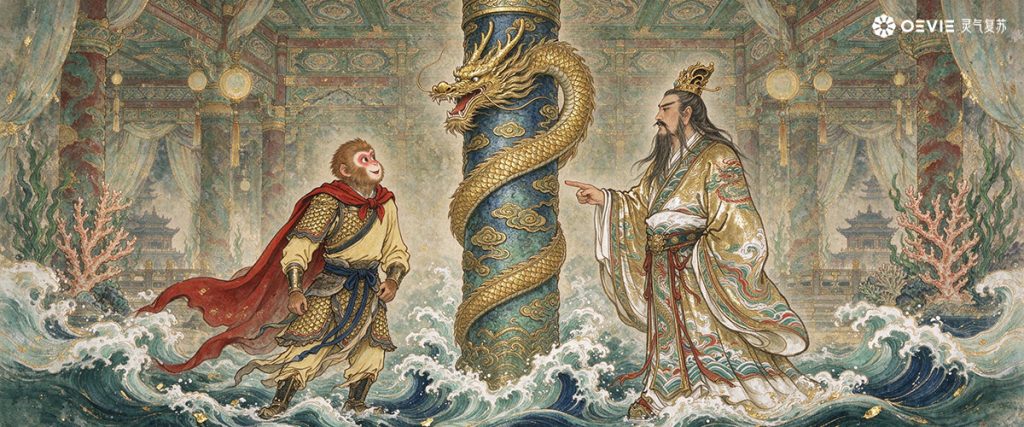
On the Mountain of Flowers and Fruit, the Handsome Monkey King Sun Wukong trained his monkey troops in martial arts but lacked a worthy weapon. An old monkey told him that the Dragon Palace of the Eastern Sea held countless treasures. Wukong used a water-parting spell, divided the waves, and plunged straight into the Dragon Palace. The Dragon King Ao Guang offered him a great saber, a nine-tined fork, and a halberd — all of which Wukong found too light. At last, the Dragon King showed him the Dinghai Shenzhen, a divine iron left by Yu the Great when he tamed the floods — the Ruyi Jingu Bang, weighing 13,500 jin. Wukong approached it and murmured, “A bit shorter and thinner would do.” The treasure shrank by several feet and thinned by a circle. He murmured again, and it shrank further. Holding the staff in his hand and twirling it, Wukong was overjoyed. The Dragon King, however, regretted his promise and reported Wukong to Heaven, accusing him of seizing the weapon by force and disturbing the Dragon Palace. This was the most direct spark that led to the Havoc in Heaven.
2. Erasing His Name from the Register of Life and Death
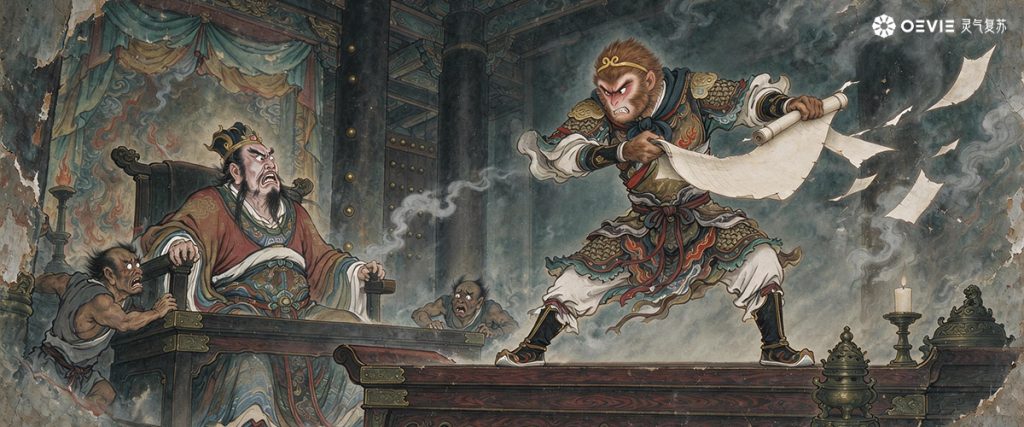
After returning to the Mountain of Flowers and Fruit, Wukong one day got drunk and was dragged in a dream by two soul-hooking demons to the Netherworld. He flew into a rage: “Old Sun has transcended the Three Realms and is not within the Five Elements — I am no longer under his jurisdiction! How dare you come to arrest me in the dark?” He brandished his Jingu Bang, stormed into the Hall of Yama, and demanded that the Ten Kings of Hell bring him the Register of Life and Death. Wukong examined it himself and found his name under the character “Soul,” number 1,103. He crossed out the names of all monkeys and monkeys with one stroke of his brush, threw the register down, and declared: “Settled! Settled! From now on, I am not under your jurisdiction!” He brandished his staff and burst out of the Netherworld. The Kings of Hell and the Dragon King both reported to Heaven, and the Jade Emperor decided to send troops to subdue him.
3. The Insult of the "Bi Ma Wen"
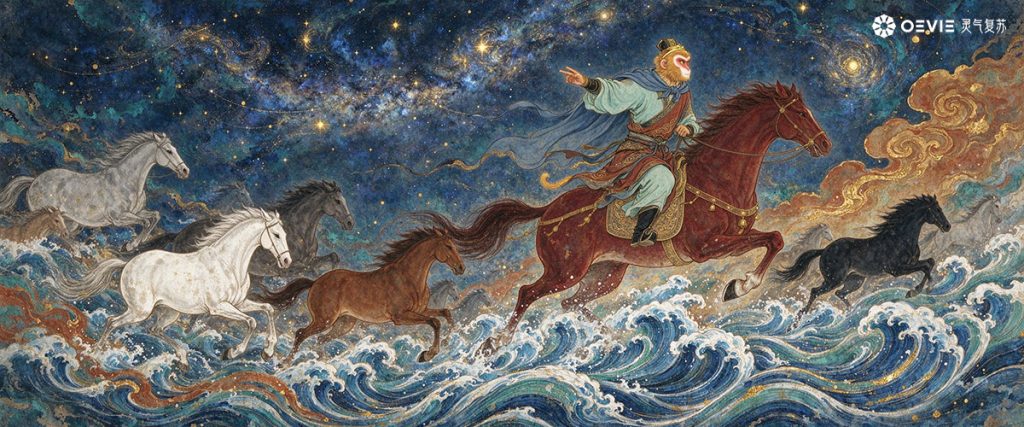
The Great White Planet suggested to the Jade Emperor a policy of pacification. Wukong was lured to Heaven and granted the post of “Bi Ma Wen” — Keeper of the Imperial Horses. At first Wukong, not knowing better, tended the horses with all his heart, making them fat and strong. One day he asked a colleague what rank his post held, only to learn that Bi Ma Wen was an unranked, lowest-grade menial position — “fit only for tending horses.” Wukong was furious: “How dare you despise Old Sun like this! On the Mountain of Flowers and Fruit, Old Sun was a king and an ancestor — how dare you trick me into tending horses for him? Horse-tending is a lowly task for the young and base — how is that fitting for me? I will not do it! I will not do it! I am leaving!” He overturned the desk, drew his Jingu Bang, and burst out of the Southern Heavenly Gate, returning to the Mountain of Flowers and Fruit. Wukong proclaimed himself “Qitian Dasheng” — the Great Sage Equal to Heaven.
II. The Process — Escalation and Outbreak
1. The Truth in the Peach Garden
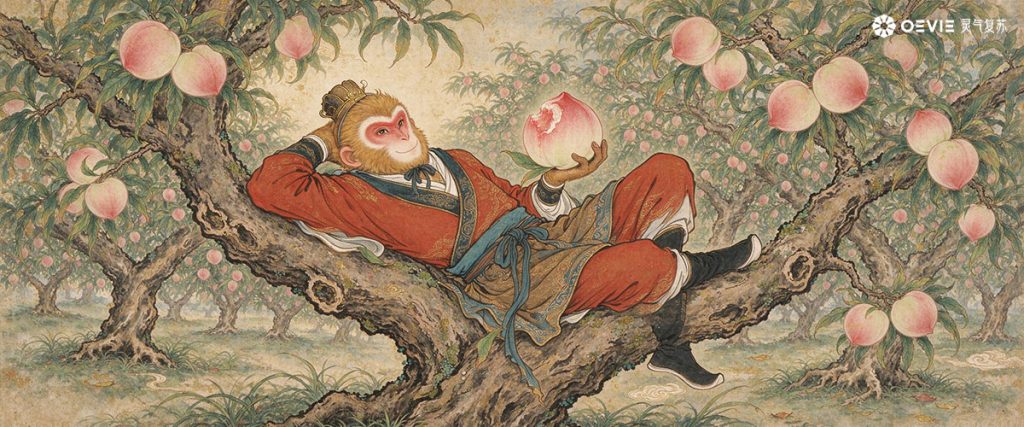
After receiving the title “Great Sage Equal to Heaven,” Wukong had nothing to do and wandered about. The Jade Emperor assigned him to manage the Peach Garden. Wukong asked the Local Earth God and learned that the immortal peaches in the garden came in three kinds: the front trees ripened once every three thousand years — eating them made one an immortal and set one on the Dao; the middle trees once every six thousand years — eating them made one ascend to Heaven in glory; the back trees once every nine thousand years — eating them made one equal to Heaven and Earth in lifespan, and to the sun and moon in age. Wukong was overjoyed. He sent the Earth God and the guardians away, climbed the great trees, picked the ripest and largest peaches, and enjoyed them freely on the branches. From then on, every three to five days, he would find a way to steal peaches and eat his fill.
2. The Insult of Exclusion from the Peach Banquet
One day, the Queen Mother of the West sent seven fairy maidens to pick peaches in preparation for the Grand Peach Banquet. From the maidens, Wukong learned that the Queen Mother had invited all the immortals of the Three Realms — the Buddhas and Bodhisattvas of the Western Heaven, the holy monks and arhats, the Guanyin of the South, the Sage Emperor of the East, the immortal elders of the Ten Continents and Three Isles, the Dark Spirit of the North, the Yellow-Horned Great Immortal of the Center — all the great and small deities of every palace and hall. Only he, the “Great Sage Equal to Heaven,” had not been invited. Wukong’s fury was ignited. He froze the fairy maidens and stormed straight to the Jade Pool. The banquet had not yet begun, but the tables were already laden with dragon livers and phoenix marrow, bear paws and ape lips, jade liquid and ambrosia. Wukong plucked a hair, transformed it into several sleep-inducing insects, and put all the wine-making officials, grain-sifting laborers, water-carrying attendants, and fire-tending boys to sleep. He ate and drank his fill, grew drunk and merry. Before leaving, he packed the remaining fruits and delicacies into a bag to take back to the Mountain of Flowers and Fruit for his monkeys.
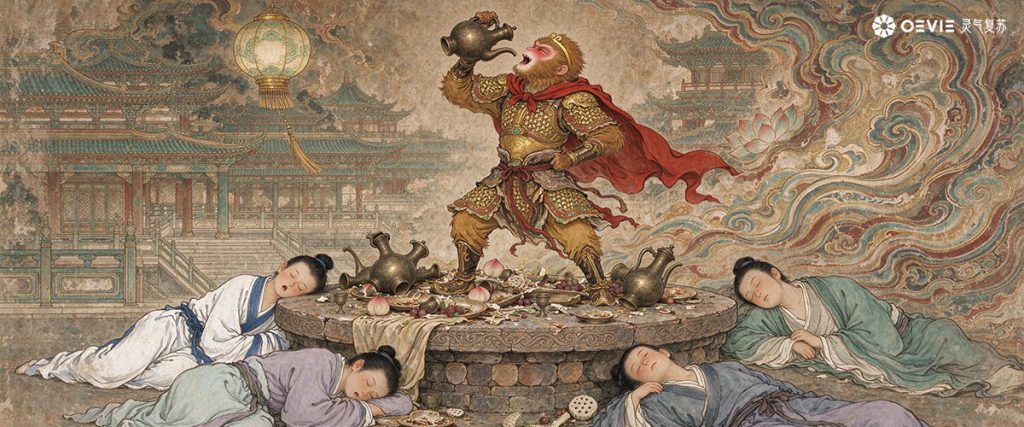
3. Drunken Intrusion into the Tushita Palace
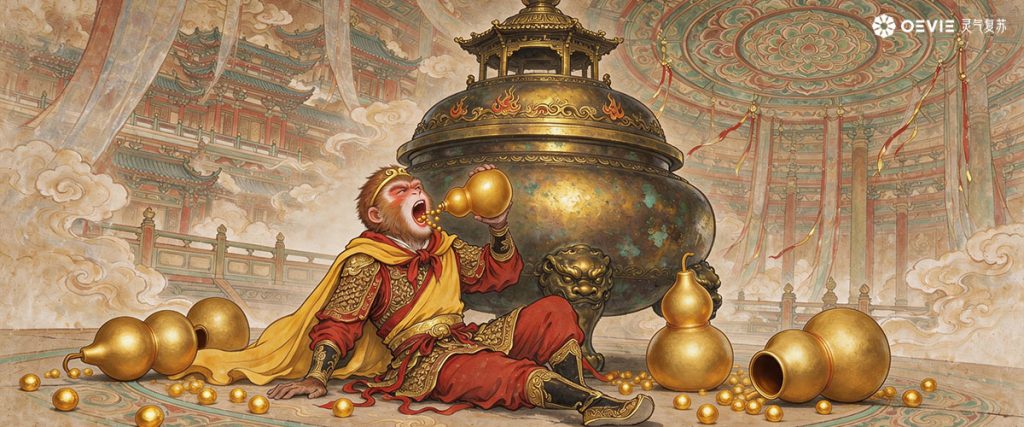
Wukong drunkenly left the Jade Pool, wandered off the path in a daze, and arrived at the Tushita Heavenly Palace above the thirty-third heaven — the dwelling of the Supreme Old Lord. Seeing no guards, he barged in. In the elixir chamber, the Supreme Old Lord was lecturing on the Dao with the Ancient Buddha Dipankara on the Vermilion Mound, while immortal boys, generals, officials, and clerks stood in attendance. Wukong went straight to the elixir chamber and saw five gourds beside the elixir stove, all filled with perfected golden elixirs. Wukong was delighted: “These are the supreme treasures of the immortals! Since Old Sun attained the Dao, I have understood the principle of inner and outer sameness, and I too wished to refine some golden elixirs to help others — but never had the chance. Today fate has brought me here, and I have stumbled upon these — while Laozi is away, let me eat a few pills and taste something new.” He poured out all the gourds and ate them all, like eating roasted beans. After finishing the elixirs, his drunkenness wore off, and he realized he had committed a catastrophic crime. He made a hand gesture, escaped through the Western Heavenly Gate, and returned to the Mountain of Flowers and Fruit.
III. The Climax — The Great Battle and the Furnace
1. The Hundred Thousand Heavenly Troops Besiege the Mountain
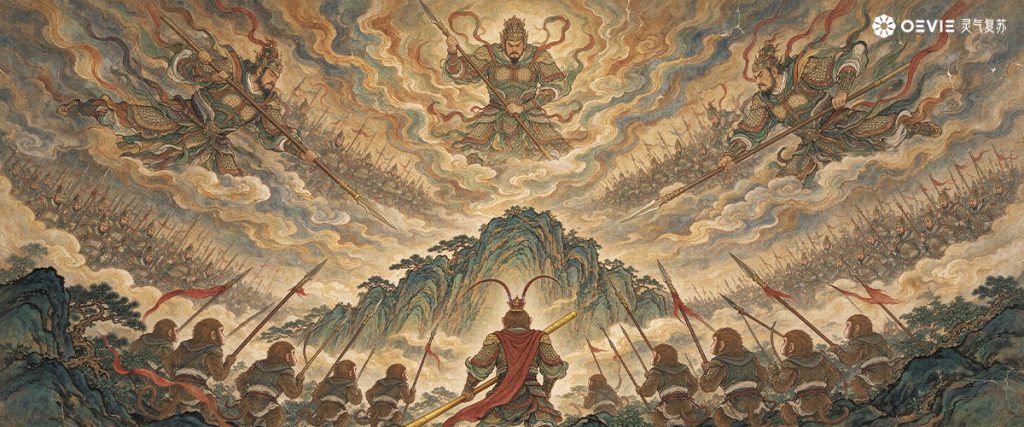
The Jade Emperor appointed Li Jing, the Pagoda-Bearing Heavenly King, as Grand Marshal for Subduing Demons, and Prince Nezha as Great Spirit of the Three Altars and Seas, commanding a hundred thousand heavenly soldiers and generals to spread a net across the sky and besiege the Mountain of Flowers and Fruit. The vanguard giant spirit god was the first to fight — Wukong broke the handle of his axe with one blow, and he fled in defeat. Prince Nezha transformed into a three-headed, six-armed form, wielding six weapons, and fought Wukong for thirty rounds without victory or defeat. Wukong plucked a hair, transformed it into his own true form to fight Nezha, while his real body slipped behind Nezha and struck him on the left shoulder. Nezha fled in pain. The first siege by the heavenly troops had failed.
2. Erlang Shen and Wukong's Contest of Transformations
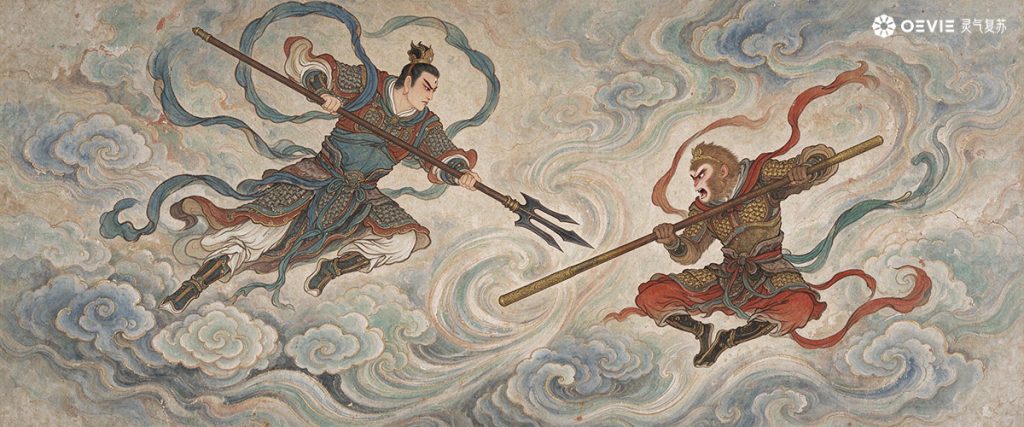
Guanyin Bodhisattva recommended Erlang Shen to the Jade Emperor. Erlang Shen went forth by imperial decree and engaged Wukong in a breathtaking contest of transformations. Wukong turned into a sparrow — Erlang turned into a hungry hawk; Wukong became a cormorant — Erlang became a sea crane; Wukong became a fish — Erlang became a fish hawk; Wukong became a water snake — Erlang became a gray crane; Wukong became a bustard — Erlang shot at him with a pellet bow, and Wukong rolled down the cliff, transformed into a land temple — his mouth was the temple gate, his teeth the door leaves, his eyes the window lattice, and his tail became a flagpole, erected behind the temple. Erlang arrived and saw the flagpole behind the temple. He laughed: “It’s that monkey! He’s trying to fool me again. I have seen many temples, but never one with a flagpole behind it. It must be this beast playing tricks!” Seeing that he had been discovered, Wukong leapt up to the clouds and fled to the Guan River mouth. Erlang pursued him there, and the two fought again.
3. The Supreme Old Lord's Ambush and the Eight Trigrams Furnace
While Erlang Shen and Wukong were locked in fierce battle, the Supreme Old Lord watched from above, took a diamond snare from his sleeve, and threw it down, striking Wukong on the head. Wukong stumbled, and as he tried to rise and flee, Erlang’s fine hound caught up and bit him on the calf, bringing him down again. The heavenly troops swarmed in, bound him with ropes, and pierced his shoulder blades with hooks so that he could no longer transform. Wukong was dragged beneath the Demon-Slaying Platform and tied to the Demon-Subduing Pillar. Swords chopped, axes hewed, spears stabbed, and swords slashed — not one could wound him. The South Dipper Star ordered the fire gods to burn him, and the thunder gods to strike him with thunderbolts — not a hair was harmed. The Supreme Old Lord submitted: “That monkey ate the immortal peaches, drank the imperial wine, and stole the golden elixirs. My five gourds of elixirs — some raw, some refined — he swallowed them all. He has used the Samadhi Fire to forge them into one body, so he has become a body of diamond, and cannot be harmed in haste. Better let me take him and place him in the Eight Trigrams Furnace, to be refined with civil and martial fire. When my elixirs are extracted, his body will be reduced to ashes.” The Jade Emperor approved.
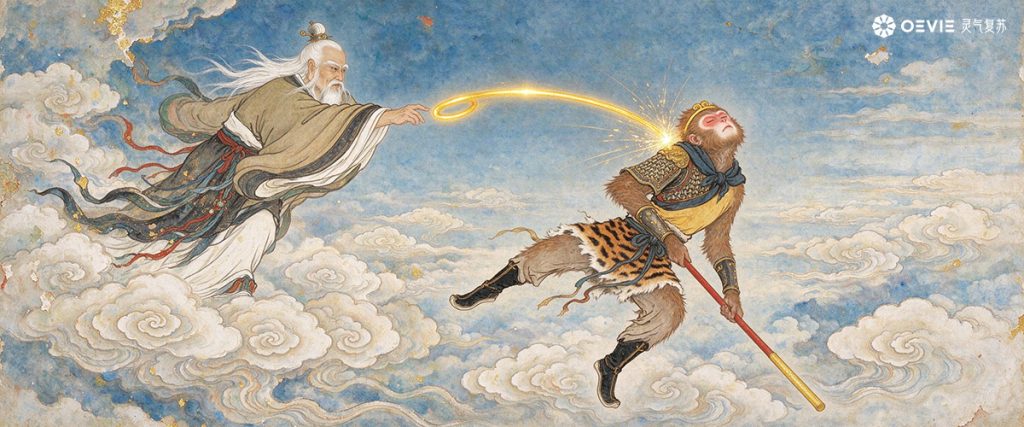
4. The Fiery Eyes and Golden Pupils Break Forth from the Furnace
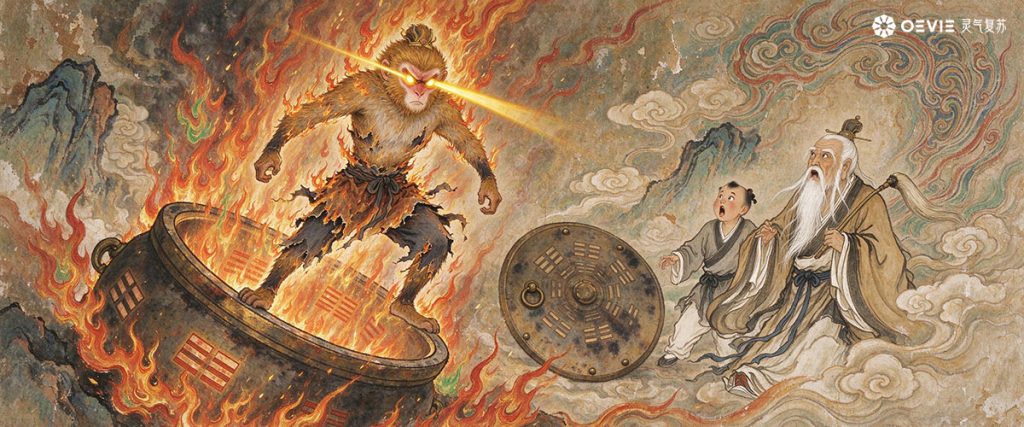
The Supreme Old Lord released Wukong from his bonds, removed the hooks from his shoulder blades, and pushed him into the Eight Trigrams Furnace, ordering the furnace-keeper and the fire-tender to fan the flames. The furnace was constructed according to the eight trigrams: Qian, Kan, Gen, Zhen, Xun, Li, Kun, and Dui. Wukong immediately burrowed into the Xun (Wind) position — Xun is wind, and where there is wind there is no fire, but the wind stirred up smoke that reddened his eyes, making them seem like the eyes of an old invalid. Thus they came to be called the “Fiery Eyes and Golden Pupils.” Time flew, and before anyone realized it, forty-nine days had passed, and the Old Lord’s fire-timing was complete. One day, he opened the furnace to retrieve his elixirs. The Great Sage, hands covering his eyes, was rubbing them and weeping, when he heard a sound from the furnace. He opened his eyes wide and saw the light — he could not restrain himself. He leaped up, burst out of the elixir furnace, kicked the Eight Trigrams Furnace over with a crash, and strode out. The fire-tenders, furnace-keepers, and guardians rushed to seize him, but he knocked them all down one by one, like a mad white-browed tiger or a frenzied one-horned dragon. The Old Lord caught up and tried to grab him, but Wukong seized him and threw him head over heels, then escaped.
5. Storming the Lingxiao Hall
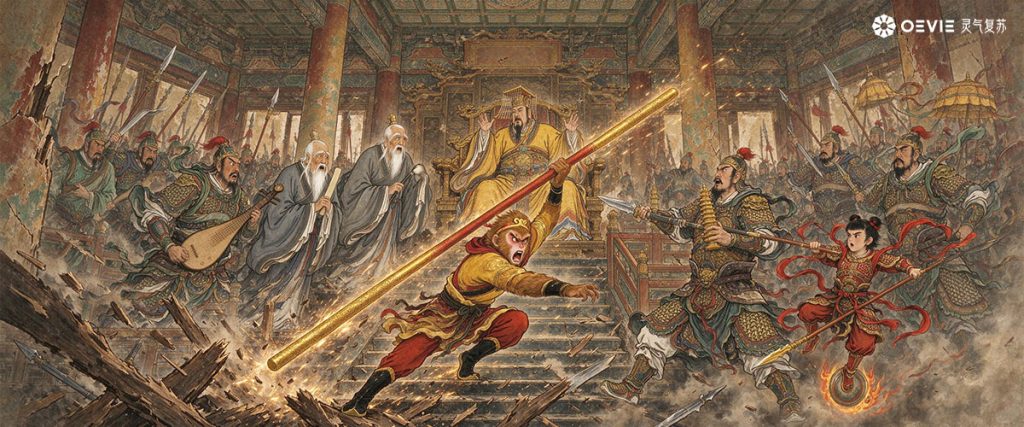
After emerging from the Eight Trigrams Furnace, Wukong drew the Ruyi Jingu Bang from his ear and, without discrimination, stormed straight into the Lingxiao Hall. The Nine Luminaries shut their doors; the Four Heavenly Kings vanished without a trace. Wukong fought his way to the Tongming Hall, outside the Lingxiao Hall. Wang Lingguan, the aide of the True Lord of Sacred Protection, blocked him with his golden whip, and the two battled fiercely before the Lingxiao Hall. Wang Lingguan was a Daoist protector deity, and he fought Wukong to a standstill. Seeing this, the Jade Emperor hastily issued an edict, sending the Wandering Spirit Official and the True Lord of Assisting Holiness to the Western Heaven to request the Buddha to subdue him. The Buddha Tathagata, hearing the summons, called the two venerable ones Ananda and Kashyapa to accompany him, left the Thunderclap Monastery, and arrived at the Lingxiao Gate. The Buddha and Wukong engaged in a famous dialogue — Wukong proposed, “The emperor should take turns — next year it will be my house,” demanding that the Jade Emperor abdicate. The Buddha made a wager with him: if Wukong could leap out of the Buddha’s palm with one somersault, the Buddha would ask the Jade Emperor to move to the Western Heaven and cede the Heavenly Palace to Wukong; if he could not, he would return to the mortal world as a demon and cultivate for several more kalpas. Wukong, confident in his powers, agreed immediately. As it turned out, one somersault cloud carried him a hundred and eight thousand li — yet he remained within the Buddha’s palm. The Buddha turned his palm over and transformed his five fingers into five connected mountains of metal, wood, water, fire, and earth, named the “Five Elements Mountain,” and gently pressed Wukong beneath it.
IV. The Ending — Suppression Beneath the Mountain
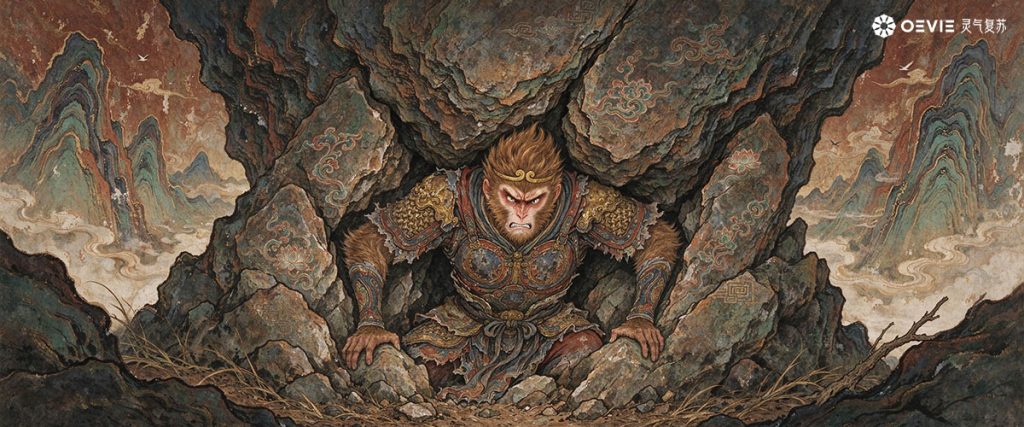
Wukong was pressed beneath the Five Elements Mountain, with only his head and one hand exposed. The Buddha Tathagata ordered the Local Earth God and the Five Directions Guardians to reside on the mountain and keep watch, feeding him iron pellets when hungry and molten copper when thirsty. Wukong struggled beneath the mountain but could not move at all. He cried out: “Tathagata! I never submitted to you — how did you trick me and press me here?” The Buddha replied: “You monkey, all fists and no kindness. Now that you are pressed here, who knows when you will ever get out.” Wukong was pressed beneath the Five Elements Mountain for a full five hundred years. After five hundred years, Guanyin Bodhisattva, on the Buddha’s decree, traveled to the Eastern Land to find the scripture-seeker. Passing the Five Elements Mountain, Wukong pleaded desperately. Guanyin instructed him to wait for the Tang Monk to come and rescue him, and promised that he would become the scripture-seeker’s disciple, protecting him on his journey to the Western Heaven to fetch the scriptures, with rewards to follow upon success. Wukong agreed eagerly. From then on, the “Great Sage Equal to Heaven” of the Havoc in Heaven transformed into “Sun Xingzhe,” the Pilgrim, on the scripture journey. One legend of rebellion drew to a close, and another journey of cultivation was about to begin.
V. Folk Story vs. Journey to the West — Key Differences
1. Source and the "Two-Story Mosaic"
The hundred-chapter Journey to the West is not a single, continuous original story from beginning to end. It is a mosaic of two large story cycles from different sources and different eras, with protagonists whose missions are entirely different. The first seven chapters tell the story of the “Great Sage Equal to Heaven rebelling against heavenly troops and wreaking havoc in Heaven”; the latter ninety-three chapters tell the story of “Sun Xingzhe accompanying the Tang Monk to fetch scriptures from the Western Heaven.” The scripture-seeking story derives from the historical journey of Xuanzang recorded in the Great Tang Records on the Western Regions, while the Havoc in Heaven story derives primarily from folk legends of a divine monkey. During the Song and Yuan dynasties, two independent Sun Wukong stories circulated separately among the people: one, popular in the Fujian-Guangdong region, told of an ape who proclaimed himself “Great Sage Equal to Heaven” (or “Great Sage Who Penetrates Heaven”), attracting heavenly troops to subdue him, and who defeated them several times; the other told of a Monkey Pilgrim protecting the Tang Monk on his scripture journey. Around the Yuan dynasty, the northern and southern story cycles gradually merged, and were ultimately integrated by the hundred-chapter Journey to the West into the peculiar “7 + 93” structure.
2. The Ending of the Great Sage
In the hundred-chapter Journey to the West, the ending of the Havoc in Heaven is clear: Wukong is pressed beneath the Five Elements Mountain by Tathagata for five hundred years, then rescued by the Tang Monk, embarks on the scripture journey, and ultimately attains the fruit of Buddhahood. But in folk stories, the “Great Sage Equal to Heaven” often has no clear ending. In Song-Yuan folk legends and zaju plays, after the Great Sage is defeated by heavenly troops, some versions say he was offered amnesty, some say he continued to roam freely in the mortal world, and some simply do not account for his later fate at all. This “missing ending” precisely demonstrates that the folk “Great Sage Equal to Heaven” story and the “scripture-seeking” story were originally two independent systems. The Great Sage did not need an ending of “being pressed for five hundred years and then going to fetch scriptures,” because in his own story system, he was the protagonist, and his story had its own logic and endpoint.
VI. Symbolism and Meaning of the Havoc in Heaven
1. Rebellion Against Feudal Order and the Pursuit of Equality and Freedom
The most direct symbolic meaning of Sun Wukong’s Havoc in Heaven is rebellion against the royal order and hierarchical system represented by the Heavenly Court, headed by the Jade Emperor. The Heavenly Court is a highly stratified bureaucratic system: the Jade Emperor sits at the apex, below him are various immortal officials, star lords, and heavenly generals, each with their own rank, strictly hierarchical. From the “insult of Bi Ma Wen” to the dispute over the title “Great Sage Equal to Heaven,” to the declaration “The emperor should take turns — next year it will be my house,” Wukong consistently challenged the legitimacy of this hierarchical order. Some scholars have pointed out that Sun Wukong’s Havoc in Heaven is not only a rebellion against existing political and social order, but also a persistent pursuit of the joy and freedom that people lost under the constraints of feudal ethics. Wukong’s ideals and actions — defying royal authority, opposing bondage, and pursuing equal dignity — reflect the imprint of Wang Yangming’s School of Mind and the surging civic thought of the mid-to-late Ming dynasty. From the perspective of spiritual phenomena, the Havoc in Heaven metaphorically represents the eruption and release of wild life force, representing the stage of “willfulness proceeding from the self” in the life process.
2. The Metaphor of "Mind" and the Philosophy of Cultivation
People of the Ming and Qing dynasties generally believed that Journey to the West was a reference book on methods of cultivation, and that the key to cultivation lay not with the Tang Monk but with Sun Wukong. Wukong symbolizes the “mind” — which can be understood as consciousness, the soul, the part of us that is relative to the physical body. Thus, the Havoc in Heaven speaks of “the freedom of the human mind,” while the scripture journey speaks of “the need to restrain that freedom in order to attain a deeper freedom.” During the Havoc in Heaven, the monkey must defy the world, proceeding entirely from the self; on the scripture journey, the monkey must conform to the world, learning to use his power within rules. This setup itself metaphorically represents the fundamental human condition: willfulness proceeding entirely from the self will inevitably hit a wall one day, realizing that the external world and social environment have their own rules; to survive, one’s life goals must adjust accordingly. From “Great Sage Equal to Heaven” to “Sun Xingzhe,” from rebellion to cultivation, from defying the world to conforming to it — these are two unavoidable stages in the life process.
3. Civic Culture and the Metaphor of Individual Liberation
Scholars such as Lin Geng, through close reading and comparison with marketplace fiction, corrected the old interpretation that equated the “Havoc in Heaven” simply with “peasant uprising,” revealing the affinity between the Sun Wukong figure and the heroes of the marketplace and rivers-and-lakes. Wukong carries a strong flavor of marketplace culture: he seeks status (the title “Great Sage Equal to Heaven”), cares about face and ceremony (the invitation to the Peach Banquet), values loyalty (returning to the Mountain of Flowers and Fruit to share the immortal wine with his monkeys), and is sensitive to slights (his fury at the low rank of Bi Ma Wen) — none of these are traits of a peasant uprising leader, but rather those of a rivers-and-lakes hero risen from the marketplace. Sun Wukong’s Havoc in Heaven, in a sense, is the story of an “individual” seeking recognition and respect within a vast system. What he demands is not the overthrow of Heaven, but Heaven’s acknowledgment of his existence and status. When this demand is repeatedly mocked and rejected, rebellion erupts. This narrative, against the backdrop of the expanding civic class and awakening individual consciousness in the mid-to-late Ming dynasty, resonated powerfully with its times.