Mount Wangwu: The First Cave Heaven and Blissful Land Under Heaven
In the northwest of Henan Province, on the border with Shanxi, rises one mountain. It is not tall — only about 1,700 meters — yet in the spiritual map of China, its standing far exceeds the Five Great Peaks. It is Mount Wangwu. Since the Wei and Jin dynasties, Daoism has honored it as “the First Cave Heaven Under Heaven” — foremost among the Ten Great Cave Heavens. It is the setting of the parable of the Foolish Old Man who moved the mountains, told in the Liezi. It is the sacred mountain twice sacrificed to by Emperor Xuanzong of Tang, and the retreat where the great Tang master Sima Chengzhen lived and taught for over fifty years. Li Bai, Du Fu, Bai Juyi, Han Yu, Su Shi — nearly every Tang poet whose name we know came here. It is more than a mountain. It is, in the Chinese heart, another word for unwavering faith.
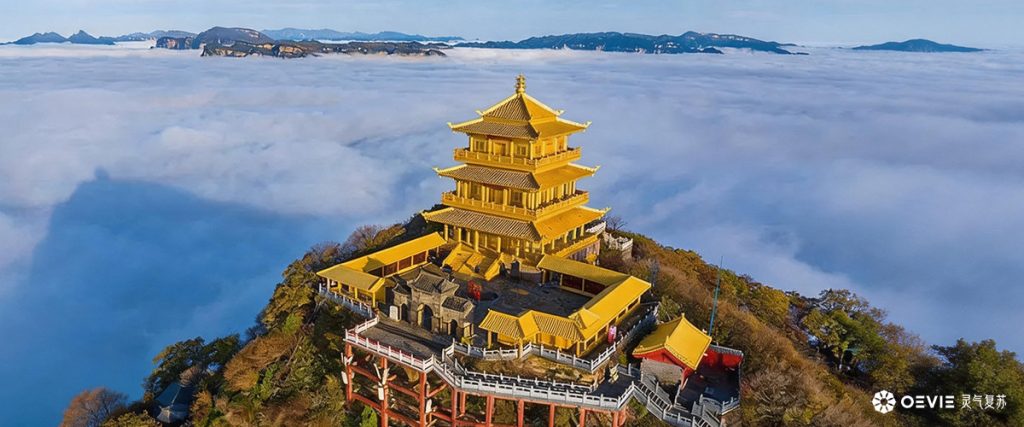
Fig.1 A sea of clouds over Mount Wangwu — green peaks layered in mist, honored as the First of the Ten Great Cave Heavens of Daoism.
1. Why It Is Called "Wangwu": A House of Kings
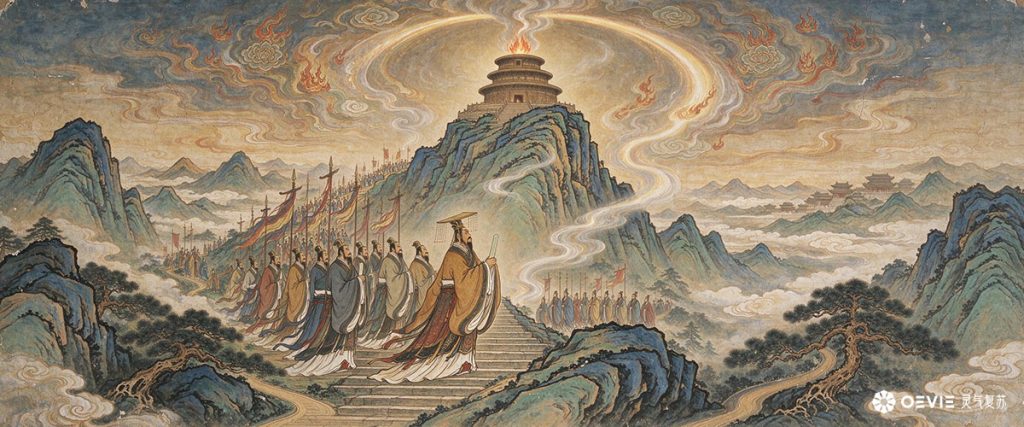
Why is it called “Wangwu”? The ancient masters said the mountain rises in three layers, its shape like a great house — wu means a thatched or tiled roof. They also said that within the mountain there is a natural cave, deep beyond entry, and inside it is as spacious as an emperor’s palace. And so this mountain became the “House of Kings,” Wangwu. The ancients believed that under the round sky and square earth, there stands at the center a mountain called Tiantan, the Altar of Heaven — this is the main peak of Wangwu. Legend says the Yellow Emperor offered sacrifices to Heaven here. Hence the saying: “Stand on Tiantan Peak, and raise your hand, and you may touch the sky.”
The mountain lies northwest of Jiyuan, Henan, touching the Taihang range to the east and the Zhongtiao range to the west, facing Shanxi to the north and the Yellow River to the south. From its summit, the Yellow River winds beneath your feet. The ancients called it “the spine of the earth.”
Fig.2 The Tiantan (Altar of Heaven) peak of Mount Wangwu — legend holds the Yellow Emperor offered sacrifices to Heaven here, making it an ancient imperial pilgrimage site.
2. The Foolish Old Man: A Two-Thousand-Year Parable
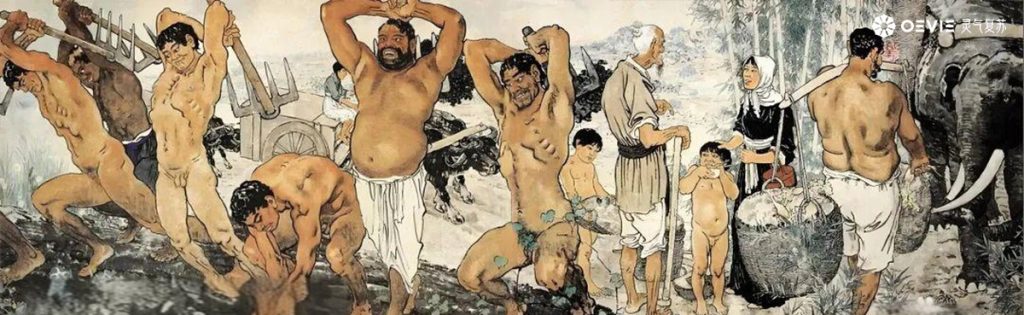
Almost every Chinese child knows the story of the Foolish Old Man Who Moved the Mountains. It comes from the Liezi · Questions of Tang. There was an old man of the North Mountain, nearly ninety, named Yugong — “Foolish Old Man.” Before his house lay two great mountains, Taihang and Wangwu, blocking the way. He gathered his family and declared he would level the mountains. A wise old man of the River Bend laughed at him: “At your age, you cannot move a single stone from these slopes — and you think you can move mountains?” The Foolish Old Man replied: “When I die, my sons remain; when my sons die, my grandsons remain. Sons beget sons, and grandsons beget sons — the line has no end, yet the mountains will not grow taller. Why should I not level them?” The Lord on High, moved by his sincerity, sent two sons of the giant Kua’e, who shouldered the two mountains away.
The two mountains in this story — Taihang and Wangwu — one in Shanxi and one in Jiyuan, Henan, are exactly these peaks. For over two thousand years, this parable has been told again and again. It is not about physical strength. It is about the sincerity of the heart. In 1945, Mao Zedong retold this story in his closing address to the Seventh National Congress — and “the Foolish Old Man moving the mountains” became one of the symbols of modern Chinese spirit. A single mountain carries the weight, from the ancient fable to the modern revolution.
Fig.3 Sculpture of the Foolish Old Man Removing the Mountains — from the Liezi, a parable of perseverance that has become a symbol of Chinese resolve.
3. Sima Chengzhen and Yangtai Palace: The Imperial Retreat of Tang
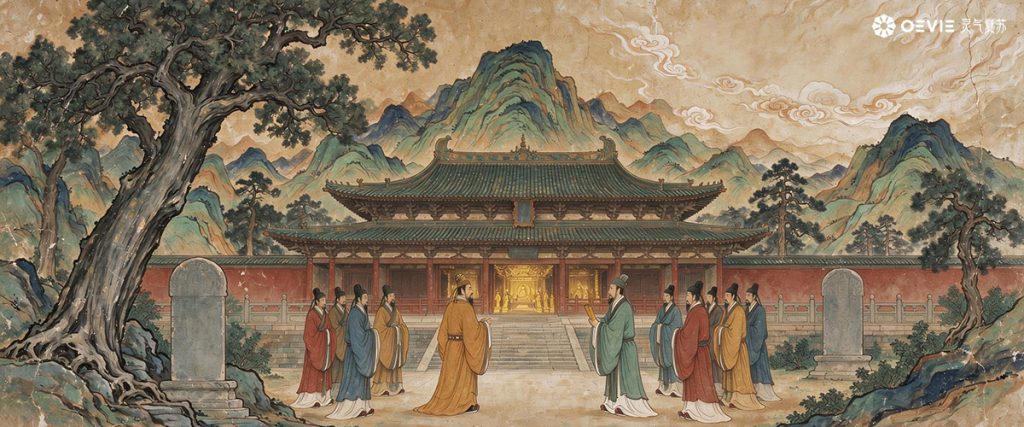
Mount Wangwu reached its greatest splendor in the Tang Dynasty. In the twelfth year of the Kaiyuan era (724), Emperor Xuanzong summoned the most renowned Daoist master of the age, Sima Chengzhen, to the capital, and personally questioned him on the Dao. Sima Chengzhen, styled Ziwei, known as the White Cloud Master, was the eleventh patriarch of the Shangqing School, in the line descending from Tao Hongjing. He refused to remain in Chang’an. He told the emperor: “The Wangwu Mountain where I practice is itself the First Cave Heaven Under Heaven.” And so Emperor Xuanzong ordered a temple to be built for him beneath the Huagai Peak — this was the Yangtai Palace. The emperor’s own sister, the Princess Yuzhen, took religious vows under Sima Chengzhen and came to cultivate on Wangwu.
Sima Chengzhen lived on Wangwu for over fifty years. He was no solitary monk. He was a great calligrapher, a great poet, a great painter. Li Bai, Du Fu, Bai Juyi, Wang Wei, Meng Haoran, all climbed the mountain to visit him. Li Bai, who had himself “sought the sword at fifteen and called on the lords,” wrote of his stay in this temple: “I would follow Ziwei, and kindle the cinnabar alchemy fire.” One mountain, through one man, became the shared spiritual home of High Tang literature. Today, Yangtai Palace still keeps its Tang-era bodhi trees, its Yuan-dynasty stone lions, and its Ming-dynasty iron bell. It is among the most complete clusters of Ming and Qing architecture surviving in Henan.
Fig.4 The Yangtai Palace on Mount Wangwu — built by imperial command of Emperor Xuanzong of Tang for the master Sima Chengzhen, preserving Tang cypresses and Yuan-dynasty stone tablets.
4. "First Cave Heaven Under Heaven": A Cliff Inscription Echoing a Thousand Years
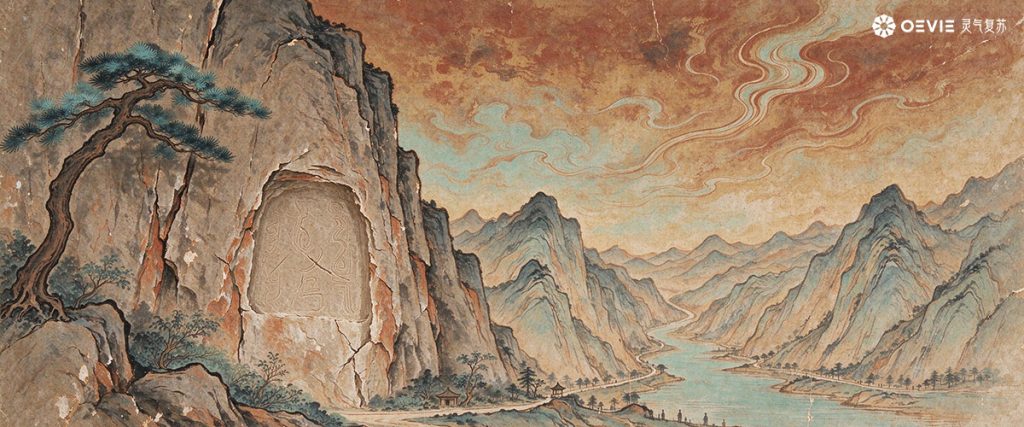
On a cliff northeast of Yangtai Palace, on the main peak of Wangwu, there is a great stone inscription. Six large characters are carved into the rock: “The First Cave Heaven Under Heaven.” These six characters are traditionally attributed to Sima Chengzhen himself. Later, they were entered into the Daoist classic The Atlas of the Caverns and Palaces, and Wangwu was formally recognized as the foremost of the Ten Great Cave Heavens. What are these “Cave Heavens and Blissful Lands”? Daoism holds that among the sacred mountains of the world, there are seventy-two “blissful lands” and thirty-six “cave heavens” — secret realms where the immortals dwell, and where mortals may cultivate and attain transcendence. Among all these more than a hundred places, Wangwu stands first.
Fig.5 The cliff inscription "First Cave Heaven Under Heaven" — traditionally attributed to the Tang master Sima Chengzhen, marking Mount Wangwu as the foremost of Daoism's sacred sites.
From the Tang onward, emperors, scholars, and pilgrims climbed the same mountain path to see this inscription. They sacrificed to Heaven here, refined elixirs, wrote poetry, sought transcendence. Su Shi, in a poem, wrote that “even the middle reaches of the Sanggan are not so far — north of the midstream lies the horizon.” Yet he himself climbed Wangwu many times. That single title — “first” — has secured for this mountain a unique place in the spiritual world of Chinese letters, for all time.
5. Mountain People and Mountain Herbs: A Living Mountain
Beyond Daoism and the poets, Wangwu is still a “living” mountain. It holds one of the most intact temperate forests in northern China. The Wangwu Tiepi Dendrobium, the Wangwu wild honey, the Wangwu Dongling herbs, were all imperial tribute through the ages. Generations of mountain people have gathered herbs, planted tea, and raised fowl on these slopes. Every spring, they climb the ancient stone paths to the temple fair at Yangtai Palace. Every Double Ninth Festival, a solemn sacrifice is held on the mountain. Today, when you enter Wangwu, you still walk the ancient stone paths, see the old millstones, touch the scholar trees, and hear the mountain people sing folk songs that have come down for hundreds of years.
This is not a museum sealed behind glass. It is a living mountain. Mountain people live inside it. Daoists cultivate on it. Poets write on it. Travelers watch the sea of clouds. For two thousand years, Wangwu has taken all these people and all these stories into its three layered peaks — like a great natural house, sheltering the spiritual home of generation after generation of Chinese souls.