Wang Chongyang: From the Living Dead Tomb to Patriarch of Quanzhen
Anyone who has read Jin Yong’s Legend of the Condor Heroes or Return of the Condor Heroes knows Wang Chongyang, the “Central Divine,” first among the Five Greats, founder of the Quanzhen School, whose seven disciples are famous throughout the jianghu. But in real history, the ascetic of the novels was an even more remarkable man. His birth name was Wang Zhongfu, his style name Zhiming, his Daoist name Chongyangzi. He was born in Xianyang, Shaanxi, in 1112, the second year of the Zhenghe era of the Northern Song. In his youth he served as a minor official under the Jin dynasty and even led troops in battle. But at forty, he suddenly dug an underground cellar on Mount Zhongnan, called it the “Living Dead Tomb,” and lived inside it for three years. When he climbed back out, he was no longer the man who had gone down. He had become Wang Chongyang — founding patriarch of the Quanzhen School of Daoism.
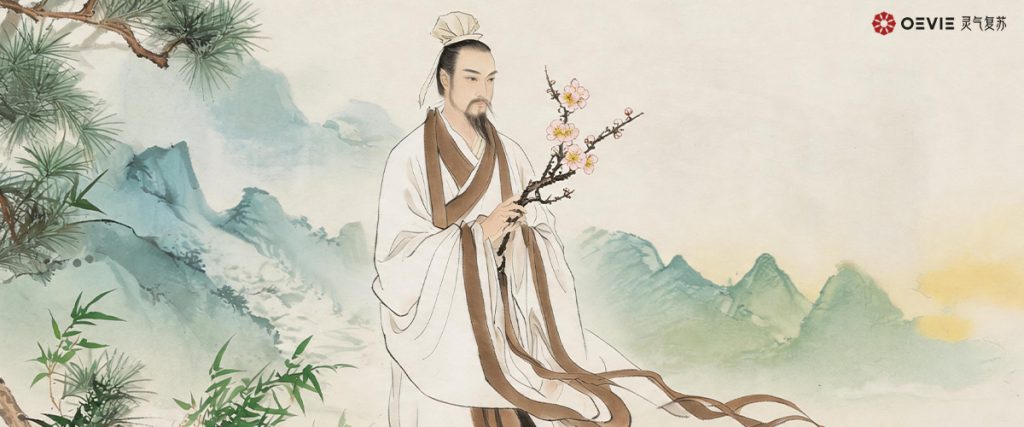
Fig.1 Wang Chongyang, robed in Daoist garb, hair bound, holding a plum blossom — founding patriarch of the Northern Quanzhen School.
1. From Scholar to "Madman": One Man's Spiritual Turning
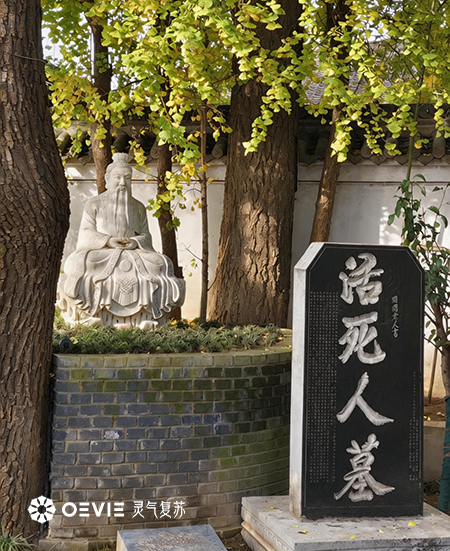
Fig.2 The site of the "Living Dead Tomb" on Mount Zhongnan, where Wang Chongyang secluded himself for three years — revered as a sacred ground of inner-alchemy Daoist practice.
In his early years, Wang Chongyang was no monk. He was born into a wealthy family in Xianyang, Shaanxi, raised on the Confucian classics and the military manuals. He lived in one of China’s most turbulent ages: the turn of the Song dynasty. The north had fallen to the Jin; the Southern Song court had fled south of the Yangtze. He sat for the Jin imperial examinations but was rejected — ugly in appearance, too plain in speech. He took the military examinations instead, passed, and was given a small post collecting wine taxes. Day after day, the work weighed on him. He watched his country torn apart, yet here he was, collecting wine duties for a foreign court.
At forty, he resigned and returned to Mount Zhongnan. Legend says that at Ganhe Town he met two immortals — later identified as Zhongli Quan and Lü Dongbin in disguise — who imparted to him the secrets of inner alchemy. From that day, he left his home. On the south side of Mount Zhongnan, he dug an underground cellar, raised a wooden tablet on four sides, and wrote on it: “Spirit Tablet of Wang the Madman.” In the local Guanzhong dialect, “haifeng” means “madman.” He lived in this cellar for three years, calling himself the “Living Dead.” A man of forty had buried himself alive in the ground, to answer one question: what is a human life for?
2. East Through Tongguan: Seven Disciples, One School
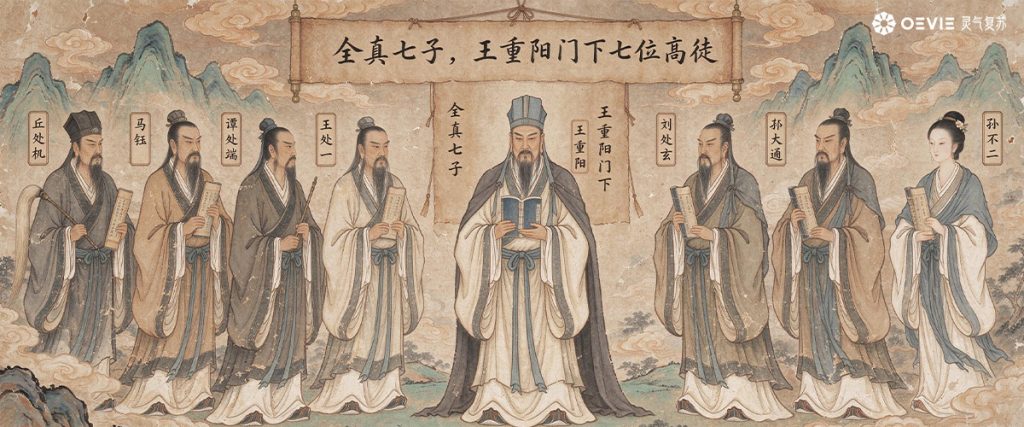
Three years later, he climbed out, burned his thatched hut, walked east through Tongguan, and reached Ninghai, in Shandong. There he met the seven people who would change his life — the famous Seven Disciples of Quanzhen: Ma Yu, Tan Chuduan, Liu Chuxuan, Qiu Chuji, Wang Chuyi, Hao Datong, and Sun Bu’er. He taught the Dao in Ninghai, opened retreats in the Kunyu Mountains, and founded five lay societies in succession — the Three Teachings Golden Lotus Society, the Three Teachings Equality Society. He demanded of his disciples: no wives, no meat, eating only what they begged, wearing clothes of paper. He wove the loyalty and filial piety of Confucianism, the meditation of Buddhism, and the naturalness of Daoism into one fabric. This is the meaning of “Quanzhen” — “fully returning to one’s true nature.”
Fig.3 The Seven Disciples of Quanzhen, seven accomplished students of Wang Chongyang, each founding his own lineage and spreading the Quanzhen School.
His most legendary work was the conversion of Ma Yu and Sun Bu’er. Ma Yu was the wealthiest man in Ninghai. Wang Chongyang came to his household and, for three months, ate only hemp and wheat, refusing wine and meat. Moved, Ma Yu abandoned his fortune and followed him. Sun Bu’er, Ma Yu’s wife, a woman of high birth, was also moved by Wang’s teaching and took her vows — becoming one of the very few female masters in the long history of Chinese religion. In less than ten years, on the Shandong peninsula, Wang Chongyang built, from nothing, a religious order that would shape China for seven hundred years.
3. Wang Chongyang's Teaching: The Wisdom of Three Teachings in One
The greatest thing about Wang Chongyang was not his mastery of breath. It was his courage to weave Confucianism, Buddhism, and Daoism into one. He required his disciples to read not only the Dao De Jing, but also the Confucian Classic of Filial Piety and the Buddhist Prajnaparamita Heart Sutra. “The gate of Confucius, the gate of the Buddha, and the gate of Laozi,” he wrote, “have always flowed from one ancestral wind.” Before him, the three traditions had often attacked one another. After him, the Chinese scholar class accepted, for the first time across the board, the ideal of “the Three Teachings in One.”
The rules he laid down for his order are astonishing even today: monks must beg their food and keep no savings; they must practice austerity and never seek ease; they must live in purity and never marry. He set the example himself. From Shandong to Shaanxi, he traveled as a beggar, carrying not a single coin. In 1170, he died in Kaifeng, not yet fifty-eight. On his deathbed he called his disciples and said: “This life is done. I will return in the next.” This is not a line from a novel. It is recorded in the official histories.
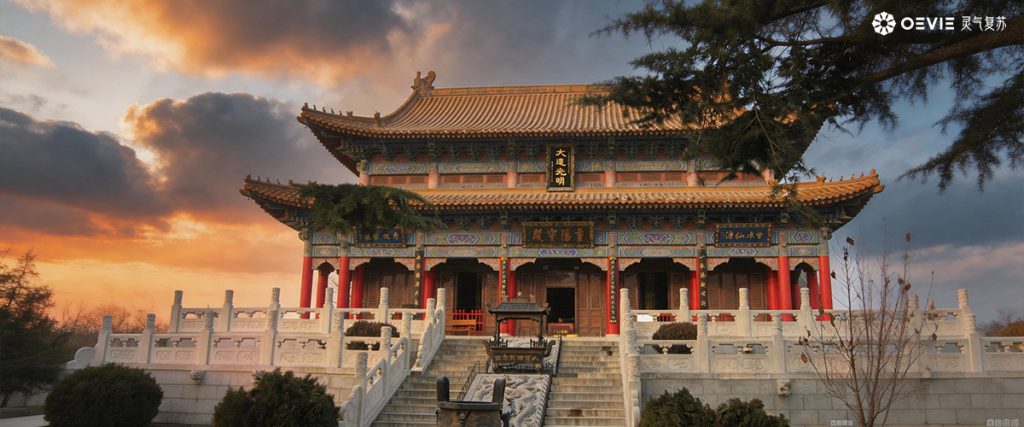
Fig.4 The Chongyang Palace in Huxian, Shaanxi — ancestral shrine of the Quanzhen School, preserving Yuan-dynasty stone tablets inscribed by leading scholars.
4. Qiu Chuji's Westward Journey: One Word That Stopped a Killing
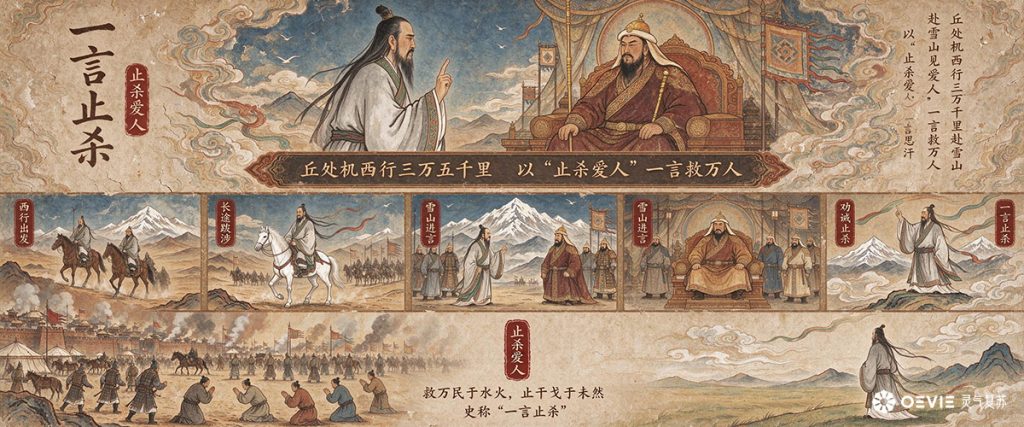
Wang Chongyang lived less than fifty-eight years, but his disciple Qiu Chuji carried his order to heights he himself never saw. In 1220, already seventy-three, Qiu Chuji set out from Laizhou in Shandong with eighteen disciples, traveling 35,000 li westward across Asia to the icy mountains of Afghanistan, to meet Genghis Khan, who was then laying waste to Central Asia. He spoke to Genghis a few words that would echo through centuries: “To live long, one must purify the heart and desire little. To rule the world, one must stop killing and love the people.” Genghis Khan called him “the Immortal,” and decreed that all Quanzhen lands were exempt from taxes, and that no Quanzhen practitioner should ever be killed.
In that very year, the Mongol armies were sacking cities across northern China. Because of this single journey, tens of thousands of people are said to have lived. It is the most famous “single word that stopped a killing” in all of Daoist history. Wang Chongyang did not live to see it. But his spirit, through the steps of a seventy-three-year-old man, turned a page in Chinese history.
Fig.5 Qiu Chuji traveling 35,000 li westward to meet Genghis Khan in the Hindu Kush, pleading "stop killing and love the people" — a single word that saved tens of thousands.
5. Wang Chongyang Living in the Martial Arts Novels
The young of today know Wang Chongyang less through the Daoist canon than through Jin Yong. In The Legend of the Condor Heroes, he is the “Central Divine,” first of the Five Greats, winner of the sword debate on Mount Hua and keeper of the Nine Yin Manual. In The Return of the Condor Heroes, the unspoken love between him and Lin Chaoying moves readers to tears. The novels are, of course, not history. The real Wang Chongyang possessed no Nine Yin Manual, fought no duel on Mount Hua, and left no story of a contest with Lin Chaoying. But Jin Yong caught his soul. A true practitioner, he understood, must be a lonely man — a man who buried himself for three years and then climbed out to bring others along. Today, on Mount Zhongnan, you can still see the site of the “Living Dead Tomb.” In Huxian, Shaanxi, you can still walk among the Yuan-dynasty tablets of Chongyang Palace. What Wang Chongyang left behind was not himself. He left a way of living. In an age when everyone rushes outward, he dared lock himself underground for three years, to ask who he was. When he climbed out of that cellar, he had already died once. From that day on, every day he lived was a gift. That, in the end, is what “Quanzhen” truly means.