Lord Guan: From a Three Kingdoms General to the Martial God of Wealth
In China, on almost every old street, you will see him: red face, phoenix eyes, silkworm eyebrows, a green robe, long beard gently stroked, seated in the most prominent place of a shop. He was never an emperor, yet he is called “Emperor.” He was never a god, yet he has been honored by a thousand years of incense. He is Guan Yu, styled Yunchang, known to the people as Lord Guan, the Martial Sage, the Martial God of Wealth. A general who, in the chaos of the Three Kingdoms, abandoned Jingzhou, fell at Maicheng, and died with his head and body separated — yet after death, he was conferred new titles by emperors thirteen times and worshipped by the common people for eighteen hundred years. In him lives the two Chinese characters that matter most: loyalty and honor.
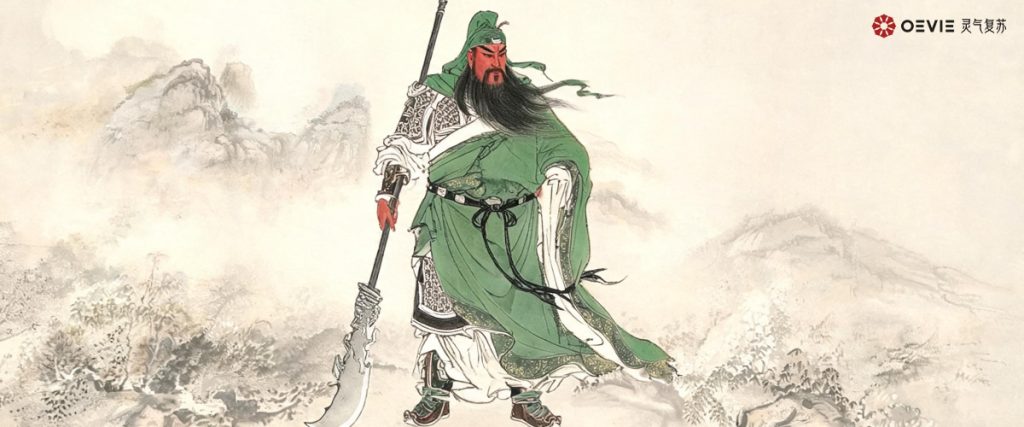
Fig.1 Lord Guan, red-faced and long-bearded, robed in green with golden armor, stroking his beard — the most familiar image of China's Martial Sage.
1. The Historical Yunchang: A Real Hero
In the official Records of the Three Kingdoms, Guan Yu, styled Yunchang, was a man of Jieliang in Hedong (present-day Yuncheng, Shanxi). In his early years he fled a trouble, and in Zhuo Commandery he met Liu Bei and Zhang Fei. The three “slept in the same bed and shared the same affection, as if brothers.” He followed Liu Bei through a hundred battles; deep in the enemy ranks he slew the great general Yan Liang and raised the siege at Baima, and was enfeoffed by Cao Cao as the “Marquis of Hanshou.” For a time his might shook all China. He flooded the seven armies, captured Yu Jin and slew Pang De, and so terrified Cao Cao that he once considered moving the capital to avoid his edge. Yet he was proud and self-regarding, looked down upon the Eastern Wu, and at last, careless, lost Jingzhou. He fell back to Maicheng and was killed at Linju by a subordinate of Sun Quan. He was about fifty-nine years old.
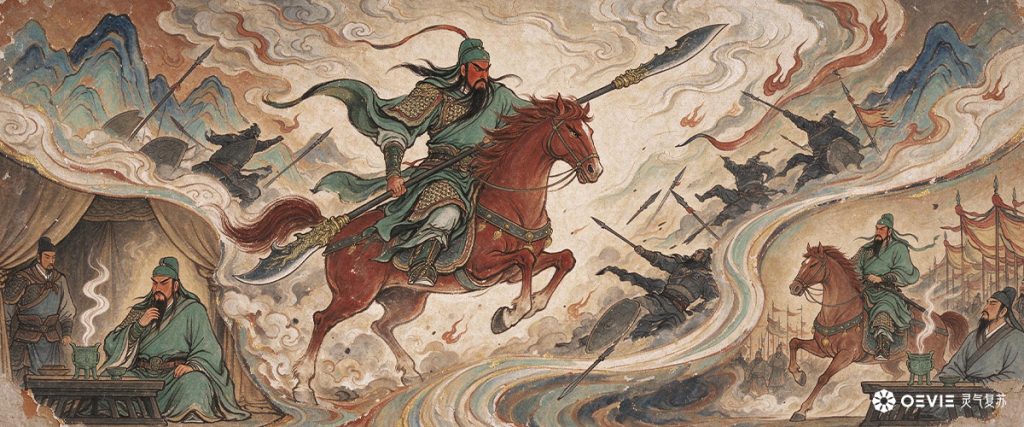
Fig.2 A classic scene from Romance of the Three Kingdoms: Guan Yu slays Hua Xiong before the wine in his cup has even cooled.
Chen Shou, who wrote the official records, says his “might shook all China” — yet he was “proud and self-regarding.” He was no perfect man. He was arrogant, he looked down on scholars, he once wished to ride to Shu to test his strength against Ma Chao. Yet it was this imperfect man who, when Cao Cao showered him with gifts — gold and silver, horse and chariot — left every reward untouched, mounted a horse, and rode back to Liu Bei, who was then a refugee with nothing. “He remained loyal to his master and did not forget his origin,” Cao Cao sighed. “A man of honor, the whole world over.”
2. From General to God: Eighteen Hundred Years of Titles
After his death, Guan Yu was at first no more than a ghost worshipped by local villagers. The man who truly made him a god was Emperor Huizong of the Song, a devout Taoist. Within little more than two decades, this emperor bestowed upon Guan Yu, in succession, the titles of Duke, True Lord, and Prince of Righteous Courage. From a man, Guan Yu had become a prince. In the Ming, the Wanli Emperor named him “Great Emperor of the Assisting Heaven.” In the Qing, Shunzhi, Kangxi, Yongzheng, Qianlong each added new honors; by the time of the Daoguang Emperor, his full title ran to twenty-six characters — “Loyal, Righteous, Divine, Martial, Spiritual, Protecting, Benevolent, Brave, Majestic, Illustrious, Great Sage Emperor Guan.”
Alongside Confucius, the Civil Sage, he was known as the Martial Sage. Qing emperors held him up as the model of loyalty to the throne, so that soldiers, officials, and commoners all worshipped him together. From the great Guandi Temple of Xiezhou to the temples of Jingzhou, from the Grove of Guan in Luoyang to the Tomb of Guan in Dangyang, temples rose across the land. At its height, China counted over three hundred thousand Guandi temples — a hundred times more than the temples of Confucius. He became the most widely housed god in all of China.
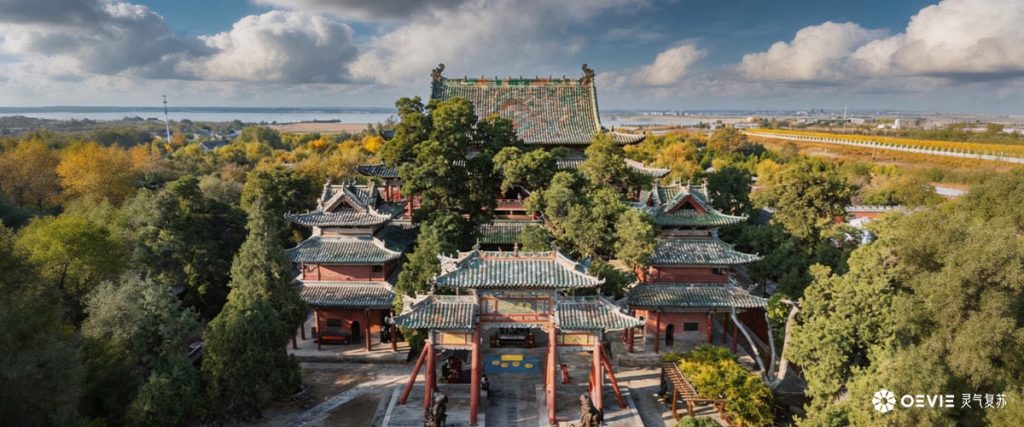
Fig.3 The Guandi Temple in Xiezhou, Shanxi — honored as the "ancestor of all martial temples" and the mother shrine of the tens of thousands of Guandi temples worldwide.
3. Why Merchants Worship Him: The Making of a Martial God of Wealth
Among the gods of wealth there are the civil ones — Bi Gan, Fan Li — and the martial one, Zhao Gongming. Yet the most popular by far is Lord Guan, who became a “god of wealth” almost by accident. Why? Because what merchants value most are two words: trust and honor. Lord Guan’s whole life — surrendering to the Han but never to Cao, traveling a thousand li alone to return to his oath brother, sparing Cao Cao at Huarong Pass — was never about profit. It was about honor. Merchants do not worship him only to gain wealth. They worship him hoping that between partners, between shopkeeper and customer, there may be the same iron promise that Lord Guan kept through life and death.
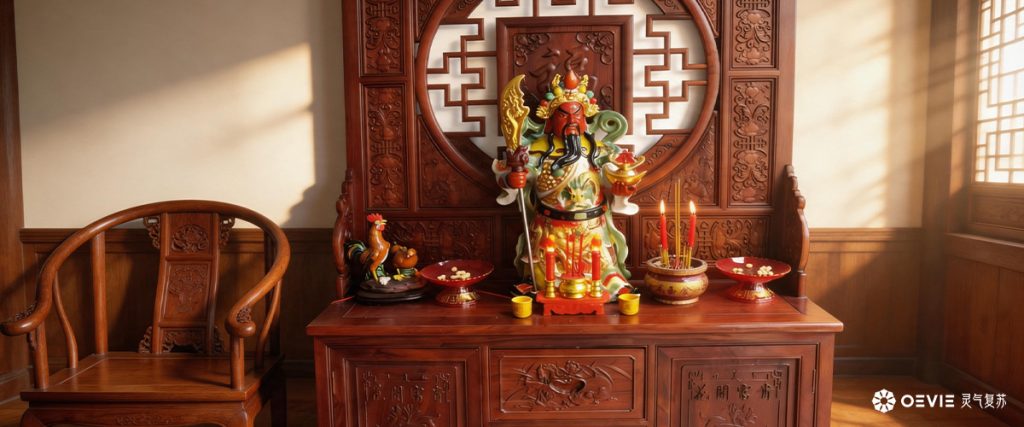
From the Ming and Qing onward, the Shanxi merchants, the Huizhou merchants, the Chaoshan merchants built Guandi temples wherever they traveled, across China and overseas. In a strange land, the Guandi temple was where merchants met, debated, and settled disputes. Lord Guan became the very symbol of commercial credit. Even today, walk into almost any Chinese-owned shop — restaurant, goldsmith, trading company — and on the counter, nine times out of ten, sits a red-faced Lord Guan, with a pair of candlesticks and a censer. It is not superstition. It is the Chinese bottom line of doing business: honor first.
Fig.4 Lord Guan enshrined in a traditional shop — red face, green robe, with candlesticks and incense, symbolizing "honor first, prosperity follows."
4. His Symbols: Red Face, the Green Dragon Blade, the Spring and Autumn Annals
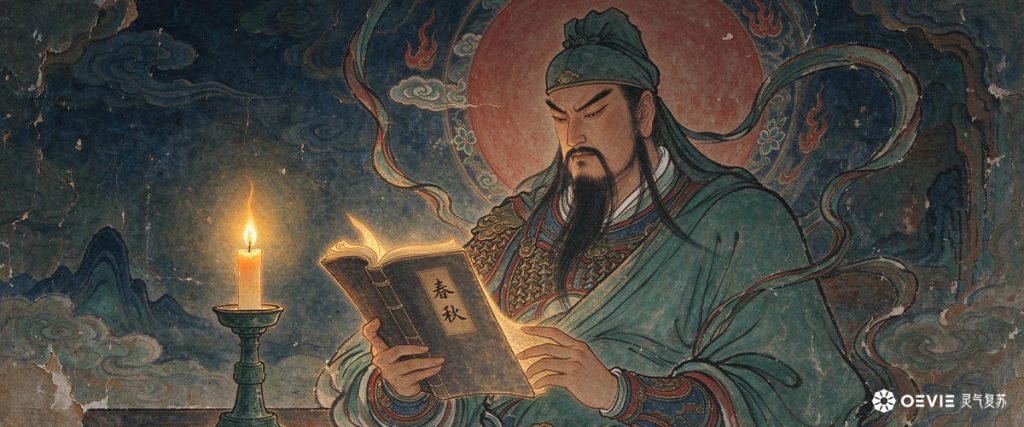
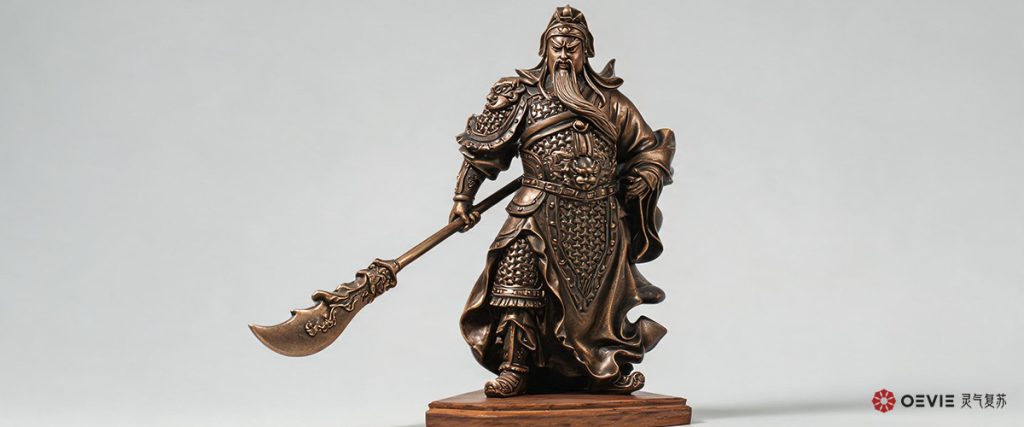
Among all the gods of China, Lord Guan’s image is the most fixed, the most instantly recognized. His red face stands for a loyal heart, upright and unwavering. His phoenix eyes and silkworm brows make him stern without anger. His five long strands of beard — the “beautiful beard” of which he was proud. His green robe — the color Liu Bei first gave him; he never changed it. In his hand, the “Green Dragon Crescent Blade,” eighty-two catties in weight. Beside him, always, lies a scroll of the Spring and Autumn Annals — legend says he read them by night, understanding the great principles of honor and history.
Every element means something. The red face is loyalty. The green robe is honor. The Annals are wisdom. The Green Dragon Blade is courage — loyalty, honor, wisdom, courage, all in one figure. He is no god who survives on magic. He is a man held in worship for eighteen hundred years because of who he was.
Fig.5 Lord Guan reading the Spring and Autumn Annals by candlelight — loyalty and wisdom in one figure.
5. Lord Guan Today: Across the Strait and Across the Oceans
The worship of Lord Guan has long since spread far beyond inland China. In Taiwan, he is among the most widely honored of all folk deities; temples like the Xingtian Temple and Zhinan Temple burn with incense year-round. In Hong Kong and Macau, the police worship him for integrity, the martial fraternities for loyalty, and the merchants for trust. In Singapore, Malaysia, Thailand, wherever Chinese communities live, Guandi temples stand side by side. In San Francisco, New York, London, wherever there is a Chinatown, there is a Guandi temple.
Today, many of us no longer read the original Records of the Three Kingdoms. Yet we still see the Green Dragon Crescent Blade in films, in video games, above the doors of tattoo parlors. What he represents is no longer only a general. He is a set of values the Chinese people share: a promise kept, life entrusted, honor first. In an age when everyone speaks only of “efficiency” and “returns,” Lord Guan still sits, silent, on the counter of every Chinese shop — like an old man who has never left, quietly reminding us: some things matter more than money.
Fig.6 Lord Guan in modern cultural-creative design: from figurines and designer toys to tattoo art, crossing generations and borders.