Mazu: From a Fisher Girl to the Goddess of the Sea
Along China’s long, winding coastline, there is one goddess whom fishermen, boatmen, merchants, and emigrants have worshipped together for generations. She did not come from the Western Heavens, nor was she born in the celestial court. She was an ordinary fisherman’s daughter on Meizhou Island, in Putian, Fujian, in the early decades of the Northern Song Dynasty. Her name was Lin Moniang. She lived only twenty-eight years, yet the ages have honored her as the Heavenly Empress, the Holy Mother of the Heavens, the Protectress of the Sea. For over a thousand years, her incense has traveled from Meizhou Island to Taiwan, to Southeast Asia, to Europe and America. More than ten thousand Mazu temples around the world welcome a hundred million bows each year. She is the warmest of all the gods of China’s southeastern shore.
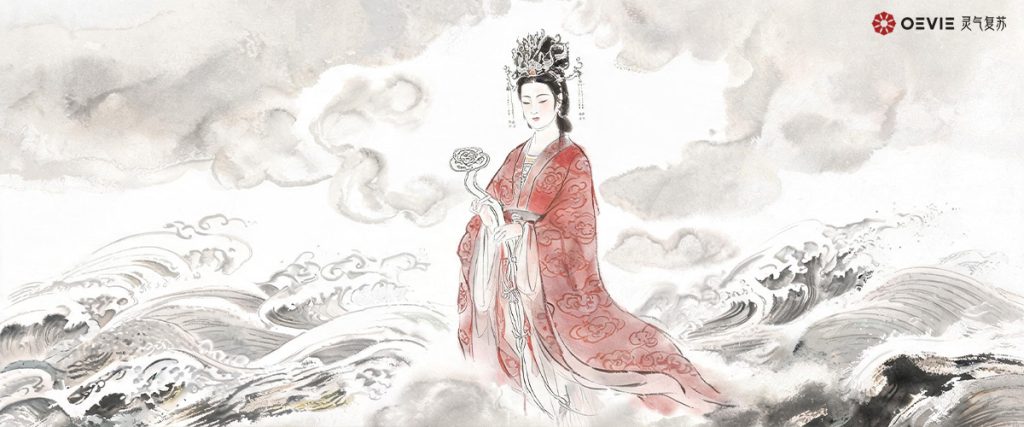
Fig.1 Mazu in a crimson robe holding a ceremonial tablet, gazing over the vast sea — the most revered sea goddess of China's southeast coast.
1. Lin Moniang of Meizhou Island
In the first year of the Jianlong era of the Northern Song (960 AD), a girl was born into the Lin family on Meizhou Island, off Putian, Fujian. Strangely, from the day of her birth to her first birthday, she had never once cried. Her father gave her the name “Lin Mo” — “Silent Lin.” From childhood she was keen and bright: she understood the stars, knew the healing art, and, above all, knew the sea. Meizhou Island is ringed by water; its people lived by fishing, and the waves were merciless. Lin Moniang would stand for hours on the reefs, gazing out to sea. Whenever a ship was in peril, she would launch her small boat and bring the drowning fishermen back, one by one. The villagers called her the “Divine Maid,” the “Dragon Daughter.”
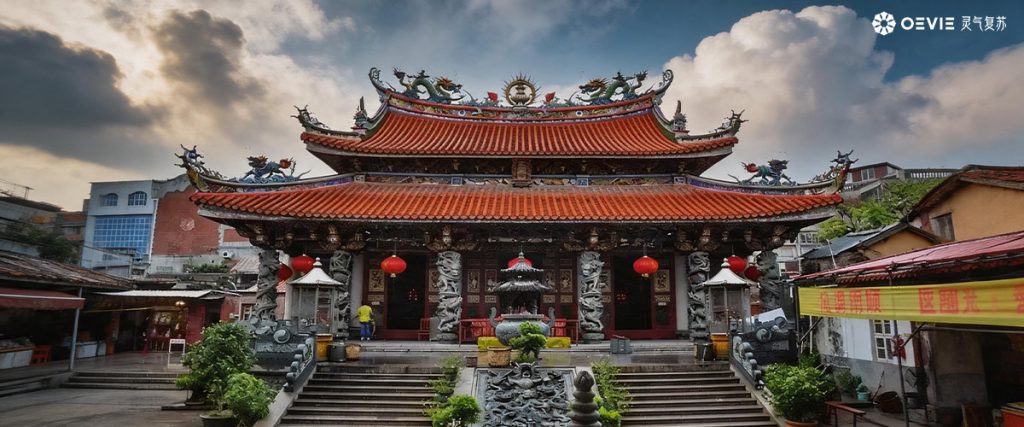
Fig.2 The ancestral Mazu Temple on Meizhou Island, Putian, Fujian — facing the open sea, the "mother temple" from which tens of thousands of Mazu temples worldwide trace their lineage.
Legend says that on the ninth day of the ninth lunar month in the fourth year of the Yongxi era (987 AD), Lin Moniang, only twenty-eight years old, “ascended and became an immortal” on the peak of Mount Mei. The islanders refused to believe she was truly gone. She had only, they said, shed her mortal form and become a goddess, still watching over them from the waves. They built a small temple on the very rock where she used to stand — this was the first Mazu temple in all the world, the origin of the Meizhou Ancestral Temple. In only twenty-eight years, a coastal girl had become the protectress of a thousand sails.
2. Saving Souls at Sea: The Legends
Nearly every legend of Mazu is tied to the sea and to saving lives. It is said she could read the weather. Before every storm, she would stand on the shore, waving her arm to warn the fishermen not to put out to sea. Once, her father and brother were caught at sea in a gale. Her mother, distraught, watched her sit with closed eyes in her chamber. Suddenly she cried out; a shoe slipped from her hand. Her spirit, it was said, had already flown out to sea to rescue her brother. But at her mother’s cry she opened her eyes and her spirit returned to her body — and in that moment, she lost her grip. She saved her father, but she could not save her brother. In this one story, Mazu moves from “marvelous” to “human.”
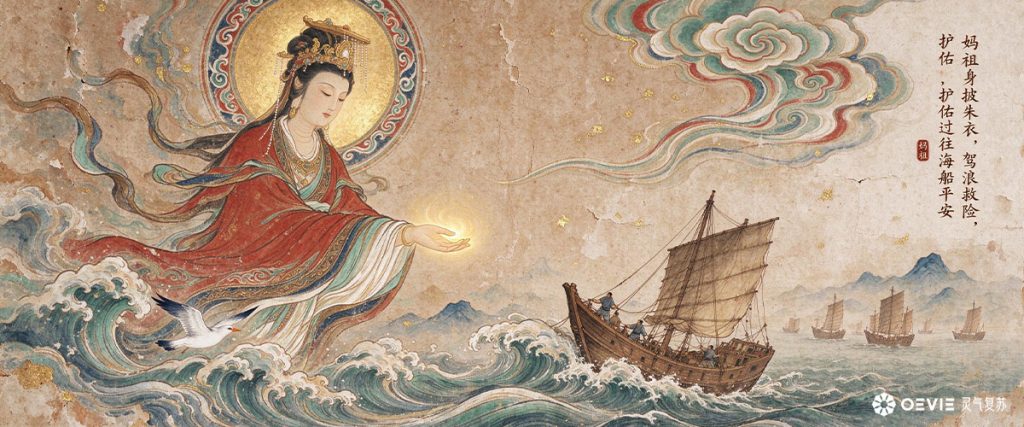
She saved not only her own villagers. Legend tells that during the Southern Song, an imperial envoy was sailing to Korea when a hurricane struck. As he prayed in the hold, he saw a woman in a crimson robe standing at the top of the mast — and at once the waves fell calm. When the envoy returned, he reported to the throne, and the emperor issued a decree of honor. From the Song onward, dynasty after dynasty bestowed new titles upon Mazu: Lady, Consort, Princess of the Sea, until, in the Kangxi era of the Qing, she was named “Heavenly Empress.” A fisherman’s daughter was honored thirty-six times by the emperors of China. In all of Chinese history, this has happened to no one else.
Fig.3 Legend tells of Mazu, robed in crimson, riding the waves to save imperiled sailors and protect every passing ship.
3. Following the Junk: Incense Across the World
The worship of Mazu traveled almost exactly along the routes of the Chinese junk. After the Southern Song, merchants from Fujian and Guangdong sailed down to Nanyang aboard Fujian-built junks; on every ship, a shrine to Mazu was always kept. Wherever they landed, they built a Mazu temple. Through the Ming and Qing, Minnan people crossed the Taiwan Strait to clear the wilderness; Mazu became their only anchor on an unfamiliar island. Today, Taiwan alone has over five hundred Mazu temples. The Dajia Zhenlan Temple, the Beigang Chaotian Temple — every year, pilgrims pour in like a tide. Later, as Chinese laborers sailed to Southeast Asia and across the oceans, the incense of Mazu traveled to Singapore, Malaya, Indonesia, the Philippines, and on to San Francisco, Paris, and Tokyo.
Fig.4 The Dajia Mazu pilgrimage procession in Taiwan, winding for over a hundred kilometers — the grandest Mazu festival in Southeast Asia.
Today there are more than ten thousand Mazu temples across over twenty countries. In 2009, “Mazu Belief and Customs” was inscribed on the UNESCO Representative List of the Intangible Cultural Heritage of Humanity. A fisher girl who lived only twenty-eight years has become a shared spiritual homeland for all the Chinese people of the world.
4. Procession and Pilgrimage: A Living Folk Custom
The most moving thing about Mazu’s faith is never the statue in the temple. It is the annual “inspection tour.” Every spring, the Mazu of the Dajia Zhenlan Temple in Taiwan sets out on foot along a fixed route for nine days and eight nights, covering over three hundred kilometers. Hundreds of thousands of people come of their own will to see her off, to walk beside her, to welcome her home. Some walk barefoot and on their knees; some bow every third step. They are not “practicing superstition.” They are walking a road their ancestors walked, rekindling a love that has crossed a hundred years.
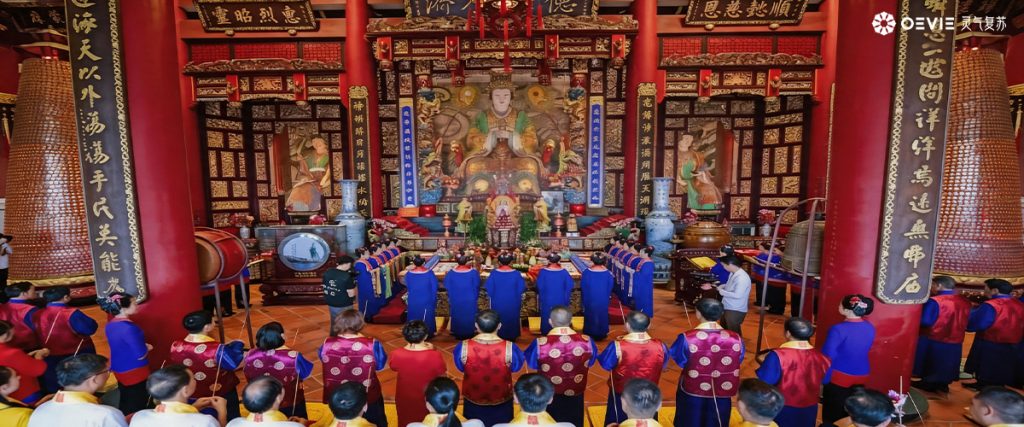
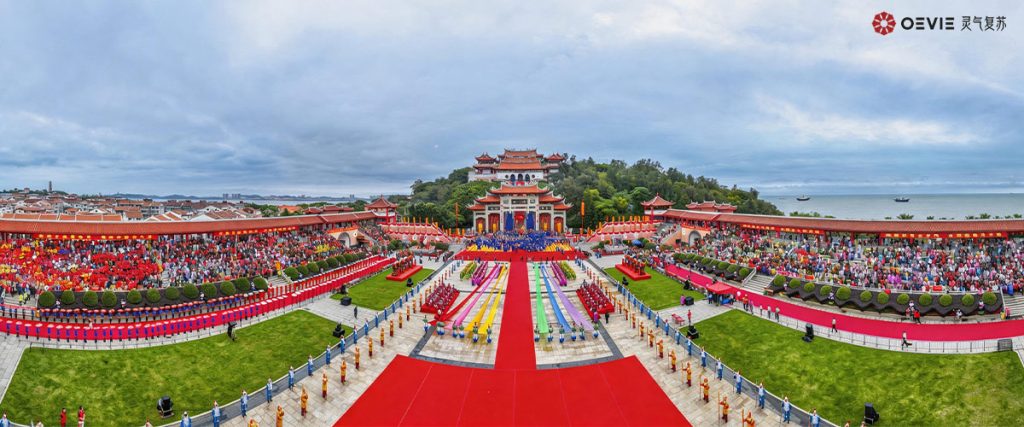
On Meizhou Island, every year on the twenty-third day of the third lunar month — Mazu’s birthday — pilgrims gather from across the world. Ritual sacrifices, the eight-rank dance, the procession of the goddess itself, all take place in great festivity. In Xiamen, Shantou, Hong Kong, on Mazu’s birthday, altars fill the streets; operas are performed; fireworks light the sky. These customs are no longer merely belief. They are a collective memory of where we came from.
Fig.5 The grand Mazu worship ceremony at Meizhou, with ancient music and ritual dances — known across the sea as the "Ceremony upon the Waves."
5. Why We Still Bow to Her Today
Today we no longer cross the ocean in wooden junks; the weather forecast is more accurate than any god. Yet the incense at Mazu’s temples has not only continued — it has grown stronger. Why? Because Mazu has never been a goddess of the weather alone. She is a goddess who listens to the cries of people. She represents the simplest Chinese feeling: before the waves, on a strange road, in a small boat far from shore, there is always someone willing to reach out and pull you back to land.
She is a daughter, an elder sister, a mother — the figure who, for every wanderer in a foreign land, stands on the shore and waves. The young today may no longer believe that a god dwells in the sea. But when they pack their bags and cross the oceans, and in some far-off city they catch sight of a Mazu temple, and hear, drifting out, the familiar Minnan chant, their eyes still fill with tears. That is not superstition. It is homesickness. Mazu is, for every Chinese soul who has ever crossed the sea, one shared mother.