
If Sun Wukong embodies the adult’s dream of freedom, then Nezha is every young person’s whole hope of rebellion. He treads on Wind-Fire Wheels, wields a Fire-Tipped Spear, carries the Universe Ring, and is wrapped in the Red Armillary Sash — a small child of a god, yet he has committed the most earth-shaking act in all of Chinese mythology: he dared to defy his own father. From the fierce youth of Investiture of the Gods to today’s national idol on the screen, crying “I decide my own fate,” the figure of Nezha has burned for nearly a millennium, and the fire only grows hotter.
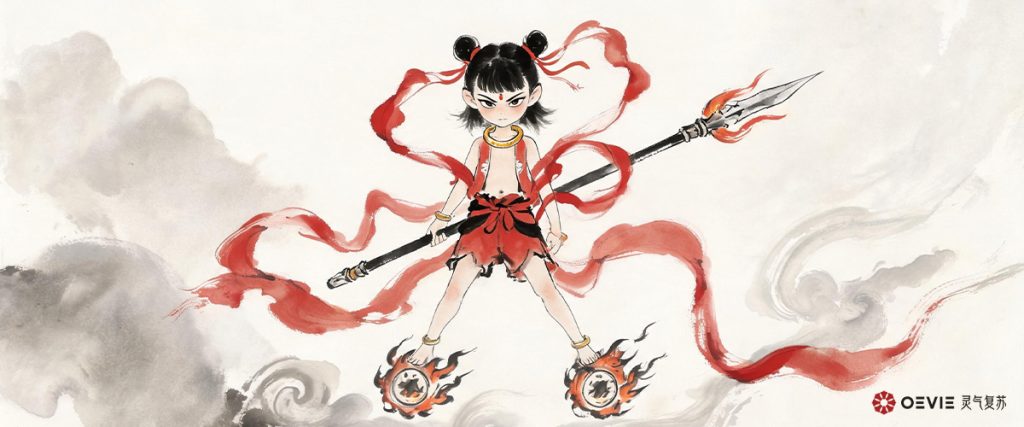
1. The Spirit Pearl Reincarnated: Third Prince of Chentang Pass
Nezha’s father, Li Jing, was a garrison commander at Chentang Pass in the final years of the Shang Dynasty. Legend says Nezha was originally the reincarnation of the Spirit Pearl from the heavens. His mother carried him for three years and six months before giving birth to a ball of flesh. When Li Jing split it open, a delicately carved infant leaped out — this was Nezha. Born with supernatural strength, at seven years old he went to bathe in the Nine-Bend River; his Red Armillary Sash stirred the Dragon Palace beneath the waves and brought disaster upon him. Ao Bing, the third dragon prince of the Eastern Sea, came to reason with him — and Nezha tore out his dragon tendon. In a rage, the Dragon King Ao Guang threatened to appeal to the Jade Emperor. Refusing to bring ruin upon his parents, the seven-year-old slit his own throat at the Southern Gate of Heaven, returning his bones to his father and his flesh to his mother — the most violent, most decisive way to pay back the debt of being born.
This is the passage that cuts deepest in all of Chinese myth. A seven-year-old child takes a blade to his own body, returning, inch by inch, the flesh and bone he was given. It is not cruelty. It is the most absolute declaration: I owe you nothing. That is why Nezha has never lived in Chinese hearts as an “obedient child.” He is the first youth in all of mythology to say, clearly and without apology: My fate is my own.
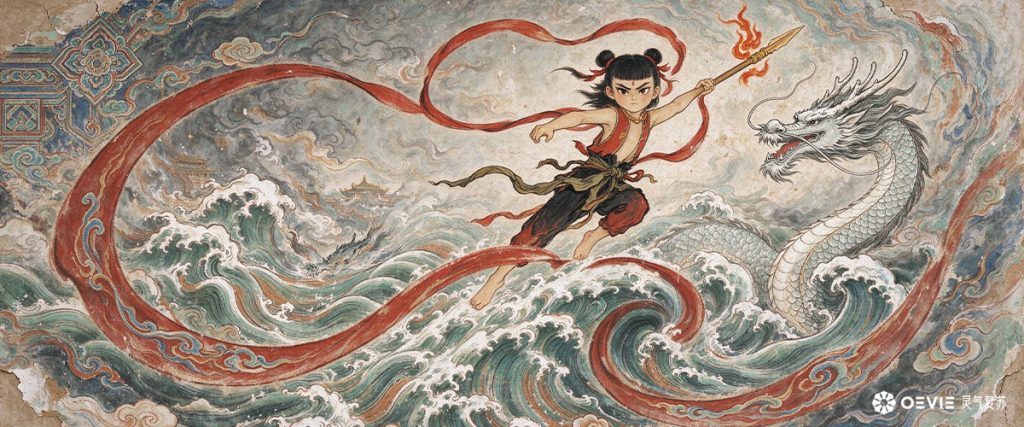
2. The Lotus Incarnation: From Death to Rebirth
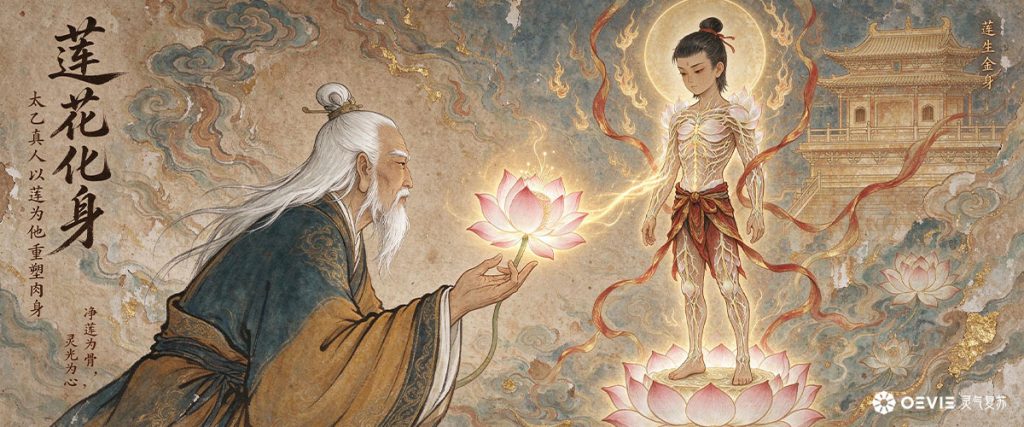
After his death, his master, the great Taiyi Zhenren, remade his body from lotus flowers, lotus leaves, and lotus roots. This is the most moving rebirth in Chinese myth. He is no longer the flesh-and-blood child of his parents; he is a lotus. From that moment, he is severed entirely from “flesh parents.” His life belongs only to himself. The lotus, in Chinese culture, has always symbolized rising unstained from mud. To give him a lotus body is to say: this youth is as clean as a flower; he lives for no one else’s expectations.
Reborn, Nezha sets out on Wind-Fire Wheels, spear in hand, to storm the Dragon Palace and burn down Chentang Pass — he has come for revenge against his father, Li Jing. Only when the Buddha of the Lamp presents Li Jing with a Pagoda of Seven Jewels, pressing Nezha beneath its weight, do father and son at last reconcile. That is the pagoda Li Jing carries ever after — the Tower-Bearing Heavenly King. So the tower was never meant to subdue demons; it was meant to subdue his own son. The metaphor, when you sit with it, is both cruel and achingly true.
3. Why Nezha Is the God of the Young
Of all the figures in Chinese myth, Nezha is the only one remembered as a child. Sun Wukong is a monkey, Guan Gong a warrior, Guanyin a gentle woman, Erlang Shen a young adult. Only Nezha is forever the little doll with two hair buns, treading on Wind-Fire Wheels. His rank is low, his title unimpressive — yet he is by far the most beloved.
Because he carries the fire that burns in every young heart. Who has never been arranged by parents, pressed by rules, suffocated by the words “it’s for your own good”? Who has never quietly cried out, Why should I? Nezha cries it out loud for us all. He tears out the dragon tendon, returns his own flesh, storms the sea, defies his father — he does the things every young heart wants to do and dares not. He is no traditional hero. He is the “problem child.” Yet it is precisely this problem child who, a thousand years on, still brings us to tears in the dark of the cinema.
4. From New-Year Prints to the Screen: A Small God Crosses Over
After the Ming and Qing dynasties, Nezha entered New-Year prints, opera, and shadow puppetry. Like Sun Wukong, he was a storyteller’s favorite. In 1979, the Shanghai Animation Film Studio released Nezha Conquers the Dragon King; the boy who, at the moment of his own death, turned his head back with eyes full of tears, became a collective memory for an entire generation. In 2019, the animated feature Nezha — with its line “I decide my own fate, not Heaven” — became the highest-grossing animated film in Chinese box-office history. Its 2024 sequel, Nezha Conquers the Dragon King II, broke every record once again.
Why Nezha? Because every generation needs a youth to rebel on its behalf. The eighties generation saw in him a childhood arranged by parents; the nineties saw an adolescence defined by labels; the post-2000s found in him a manifesto of “be yourself.” He is not the strongest figure in myth. He is simply the one who understands young people best. The fire on his wheels has burned for a thousand years, and it has not gone out.
5. My Fate Is My Own: A Gift a Youngster Leaves Us
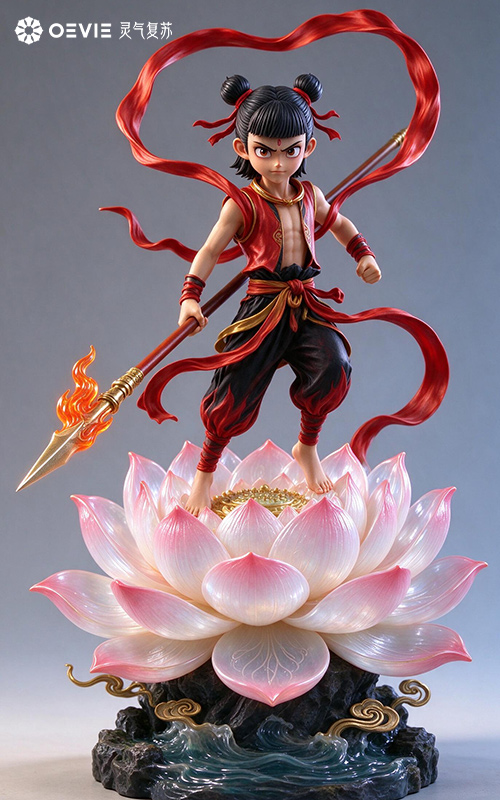
What moves us most about Nezha is never his magic. It is his purity. He is not like Sun Wukong, who must still wear the golden band and travel west for scriptures after his rebellion in Heaven. He is not like Chenxiang, who splits the mountain to rescue his mother and restore a family. Nezha’s rebellion is not for Buddhahood, not for gratitude, not for any result. He simply refuses — refuses to be arranged, refuses to be misunderstood, refuses to live as someone else’s dream merely because “you are my son.”
Today, perhaps none of us will ever tear out a dragon’s tendon or return our own flesh. Yet the fire within has never truly gone out. When we turn down a job we do not love, when we walk our own path against every gaze, when late at night we say to ourselves, This time, I want to live for me — in that moment, each of us is Nezha. He treads on his Wind-Fire Wheels, burning his way from Chentang Pass a thousand years ago, all the way into our hearts. He is no god. He is, in every young heart, the self that refuses to bow its head.